
For the Stalin government to win back the confidence of voters ahead of the Lok Sabha polls, post-flooding restoration works, their speed and efficacy would be closely watched, and not just by the political Opposition, notes N Sathiya Moorthy.
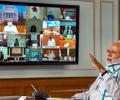
Gandhi also called upon the government to immediately put money into the hands of the poor and provide a financial package to the industry to help revive the economy.
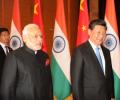
While the two sides' objectives may appear to differ, it is clear that both India and China are emphasising on the common minimum possible areas of cooperation between them, says Srikanth Kondapalli.

India's historical focus on its continental borders has overshadowed its maritime ambitions, but that is changing quickly, notes Ajai Shukla.

The big lesson to learn from the world's worst financial crisis is that nations and industry should see globalisation as a friend.

According to the report, floods (43.4 per cent) and storms (28.2 per cent) are the two most frequently occurring disasters.

Wishlist for new PM includes growth boosters, reining in inflation, faster project clearance and reversal of Land Acquisition Act
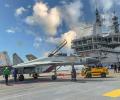
New Delhi's regional partners in restraining a belligerent China -- primarily the US, Japan, Australia and Singapore -- would like the Indian Navy to lock down the Indian Ocean Region, while the other partners can focus on deterring the PLA (navy) in the South China Sea, explains Ajai Shukla.

'The lessons learnt from the triple disaster have put Japan's energy future On the right path,' notes Dr Rajaram Panda.
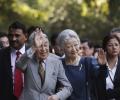
In the media frenzy over inconsequential issues, the visit of the Emperor of Japan to India has been pushed to the margins of public discourse. Colonel (retd) Anil Athale explains the great historical and political significance of the visit.

On December 26, 2004, a devastating tsunami took a huge toll on life in Tamil Nadu. A decade later, here's a look at the changes it has brought

Today's devastating quake has dealt another blow to the ailing Japanese economy, already faced with mounting debts and falling exports.
Economic activities in Japan were expected to get a boost in 2012 due to extensive reconstruction works.
Finance Minister P Chidambaram on Monday announced in the Budget for 2005-06 that the Planning Commission has drawn up Tsunami relief programme costing Rs 10,260 crore (Rs 102.6 billion).
Few people know Ratan Tata as well as R K Krishna Kumar does. Widely perceived to be among the managers closest to Tata, Krishna Kumar assesses Ratan Tata, the man and business leader, in this exclusive interview to Rediff.com's Vaihayasi Pande Daniel.

Colombo seems to be veering to the middle path between China and the US on global matters, but in regional matters of strategic security, it is increasingly identifying with India, points out N Sathiya Moorthy.

Tokyo would be an inspirational choice to host the 2020 Olympic Games, Prime Minister Shinzo Abe told Olympic officials on Monday, with Japan keen to showcase its recovery from a devastating 2011 earthquake and tsunami.

India has expressed concern that foreign fighters involved in the conflict in Syria have moved to other places as mercenaries, as New Delhi underlined that it is ready to play a constructive role in the Security Council to help realise the objective of the West Asian country reclaiming its place in the comity of nations.

India will soon make available many more COVID-19 vaccines to other countries after two Made-In-India jabs have already been introduced to the world, Prime Minister Narendra Modi said on Thursday while emphasising the country's global responsibility in fighting the pandemic.
'India is so big, of course, you can always find horror stories. The reason why you have to be optimistic is because you take the country as a whole. It seems that the trajectory is positive,' writer-historian Patrick French tells Sheela Bhatt.

'There shall be no change in India-Japan ties,' predicts Rajaram Panda.

Images from the opening ceremony of the Tokyo Olympics, at the National Stadium, on Friday.
'The only way to contain this is to see that a lesser number of people are affected.'

For the current woes of the state to end, in city after city, town after town, village after village, unauthorised constructions have to be removed, no questions asked, says N Sathiya Moorthy.

'The honourable prime minister virtually handpicked me for the Amritsar East seat.' 'Amit Shahji announced that if I am elected, the whole of Punjab will be drugs free.'
India and Indians can ignore Pakistan, but that cannot be said of other nations in the neighbourhood, where New Delhi's 'Neighbourhood First' policy constantly reverberates. Four of the eight SAARC member-nations are Muslim -- Afghanistan and Pakistan, Bangladesh and the Maldives. The rulers decide the nation's India or anti-India policy in the first two, and street-opinion contributes to the same in the latter two, points out N Sathiya Moorthy.

'This market is very expensive in some pockets, dirt cheap in some, and the belly of the market is reasonably valued.'

We knew from the moment the pandemic took hold that this would be a long haul -- at least 12 to 18 months. Nothing should have changed that assessment, says Mihir S Sharma.

In the opinion piece after the summit, the leaders said the cooperation, known as "the Quad," was born in crisis. It became a diplomatic dialogue in 2007 and was reborn in 2017.
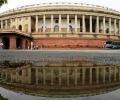
Citing rising prices, slowdown in growth and depreciation of rupee among the problems facing the economy, the opposition members said in the Lok Sabha that they feared the repeat of the 1991 crisis when the country had to mortgage gold as it failed to meet short-term debt obligations.

Meet the Chief Justice who delivered a stinging rebuke to the government last week.
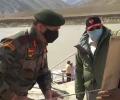
'We should not minimise the seriousness of Chinese encroachments because their perception is different.' 'Nor should we fall into the trap of accepting so-called 'buffer zones' in areas of overlapping claims. We cannot have buffer zones in our own territory,' asserts Ambassador Shyam Saran, a former foreign secretary.

The world endured bushfires, drought, tsunamis and earthquakes in 2018.
India is likely to post an impressive growth of 7.2 per cent this year and 7.3 per cent next year despite an overall slowdown in Asia-Pacific region due to adverse effects of tsunami and oil price shocks, a United Nations report said on Monday.
Three weeks ahead of the Budget, Asian Development Bank expressed concern over high fiscal deficit, which, it said, was acting as a roadblock to India's economic growth.

'The trajectory of the disease will keep increasing because of the population density being very high.'

'The steady poverty reduction achieved over the last three decades could be largely reversed in this one financial year with hundreds of millions sliding below the red line,' warns Devangshu Datta.

'The COVID-19 pandemic must push the military into a long-term reconsideration of its primary challenges.' 'There must be greater emphasis on humanitarian aid and disaster relief including the management of contagious illnesses and impending crises caused by climate change,' notes Ajai Shukla.

Labour law changes for three years may not be enough as it takes a couple of years for factories to build and operations at a proper scale start only in the third or fourth year.
